
Plant cells and animal cells are both eukaryotic cells, so they share many fundamental features. However, they are not identical. Their structures differ because plants and animals have different ways of obtaining energy, maintaining their shape, storing materials, and interacting with their surroundings.
The easiest way to understand the topic is not to memorize two separate lists. Instead, compare the structures side by side and ask why a particular structure is useful to a plant or an animal.
This guide explains the major plant cell vs animal cell differences, their similarities, important exceptions, diagrams, and exam-focused points.
Learning Objectives
After reading this article, you should be able to:resist excessive expansion when water enters the
- Identify the major features of plant and animal cells.
- Explain the main differences between them.
- Identify structures that occur in both cell types.
- Explain why plant cells need a cell wall and chloroplasts.
- Understand the role of the large central vacuole in plant cells.
- Compare plant and animal cells using a table.
- Avoid common mistakes in biology examinations.
Reading Time: 10–12 minutes
Difficulty: Beginner to Intermediate
What Is a Plant Cell?
A plant cell is a eukaryotic cell that forms part of the body of a plant.
Plant cells have a cell membrane, cytoplasm, nucleus and several membrane-bound organelles. In addition, many plant cells possess structures particularly associated with plant life, including a cell wall, plastids such as chloroplasts, and a large central vacuole.
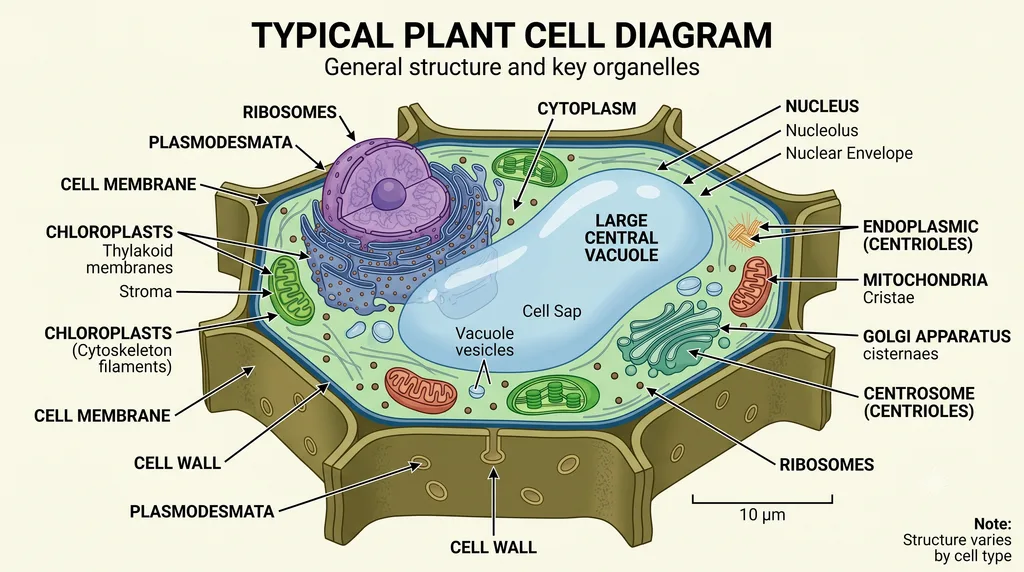
These structures help plants remain supported, capture light energy where appropriate, and maintain water balance.
However, an important point is:
Not every plant cell has chloroplasts.
For example, many cells in underground roots do not receive enough light for photosynthesis and therefore normally lack chloroplasts.
What Is an Animal Cell?
An animal cell is a eukaryotic cell that forms part of an animal’s body.
Animal cells have a cell membrane, cytoplasm, nucleus and numerous organelles. Unlike typical plant cells, animal cells do not have a cellulose cell wall or chloroplasts.
Animal cells can have many different shapes because animal tissues do not generally depend on a rigid cell wall for structural support.
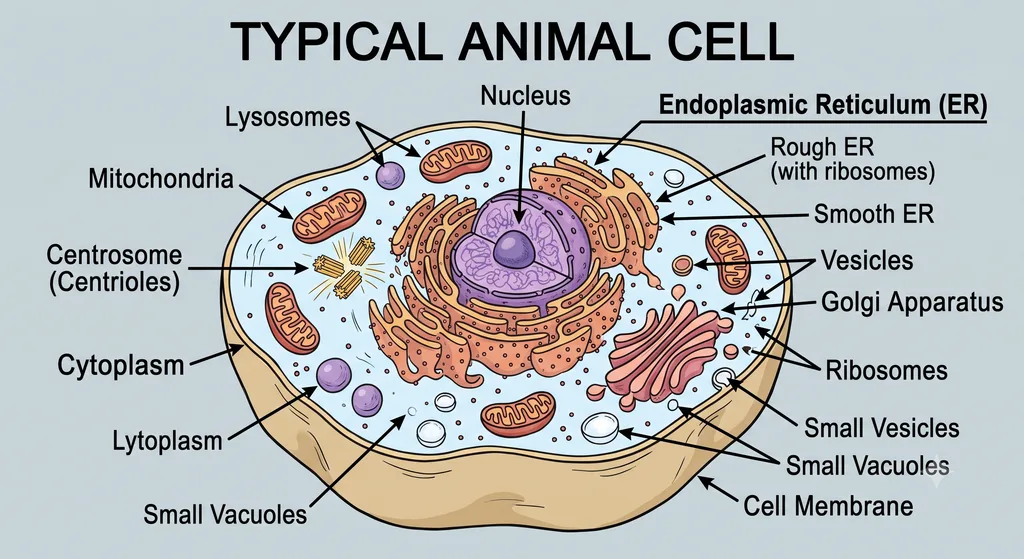
For example, a nerve cell can have long extensions, while muscle cells have elongated forms suited to their functions.
Plant Cell vs Animal Cell: Quick Comparison
| Feature | Plant Cell | Animal Cell |
|---|---|---|
| Cell type | Eukaryotic | Eukaryotic |
| Cell membrane | Present | Present |
| Nucleus | Present in most mature living cells | Present in most cells |
| Cell wall | Present | Absent |
| Chloroplasts | Present in photosynthetic cells | Absent |
| Large central vacuole | Usually present in mature plant cells | Absent as a characteristic large central vacuole |
| Smaller vacuoles/vesicles | Present | Present |
| Mitochondria | Present | Present |
| Ribosomes | Present | Present |
| Endoplasmic reticulum | Present | Present |
| Golgi apparatus | Present | Present |
| Cytoplasm | Present | Present |
| Typical centrosome with centrioles | Generally absent in higher plant cells | Characteristic of animal cells |
| Cell junctions | Plasmodesmata connect neighboring cells | Gap junctions, tight junctions and desmosomes occur |
| External support | Cell wall provides rigidity | Extracellular matrix contributes to support |
| Common energy-storage carbohydrate | Starch | Glycogen |
Important: These are general comparisons. Individual cells can have specialized structures and exceptions.
1. Cell Wall
The cell wall is one of the most recognizable differences between plant and animal cells.
Plant cells
Typical plant cells have a cell wall outside the cell membrane. The wall is composed mainly of cellulose, along with other substances such as hemicelluloses and pectins.
The wall helps:
- maintain cell shape
- provide mechanical support
- Keeps the cell from swelling excessively when water enters.
- contribute to the overall structure of plant tissues
Animal cells
Animal cells do not have a cellulose cell wall.
Instead, animal tissues obtain structural support through the extracellular matrix and interactions between cells.
Exam point
Cell wall ≠ cell membrane
The cell wall provides structural support, whereas the cell membrane is a selectively permeable boundary that regulates movement of substances into and out of the cell.
2. Chloroplasts
Chloroplasts are another major difference.
Plant cells
Photosynthetic plant cells contain chloroplasts.
Chloroplasts contain chlorophyll and are the major sites of photosynthesis in plants.
During photosynthesis, light energy is used to help convert carbon dioxide and water into organic molecules, with oxygen released as a by-product.
Animal cells
Animal cells do not contain chloroplasts.
Animals obtain organic nutrients through their food rather than manufacturing carbohydrates through photosynthesis.
Important exception
Do not memorize:
“Every plant cell has chloroplasts.”
That statement is incorrect.
Many plant cells, such as typical root cells, do not contain chloroplasts.
3. Large Central Vacuole
A mature plant cell commonly contains a large central vacuole surrounded by a membrane called the tonoplast.
The vacuole contains cell sap and can store:
- water
- dissolved substances
- ions
- pigments
- waste products and other compounds
The vacuole also contributes to turgor pressure, which helps keep many plant tissues firm.
Animal cells
Animal cells do not normally possess one enormous central vacuole comparable to that of a typical mature plant cell.
They can, however, contain smaller membrane-bound compartments and vesicles.
Easy way to remember
Plant → large central vacuole
Animal → no characteristic large central vacuole
4. Cell Shape
Plant and animal cells can have different typical shapes.
Plant cells
The cell wall restricts changes in shape and contributes to the relatively regular shapes seen in many plant cells.
Animal cells
Without a rigid cell wall, animal cells can adopt a wider variety of shapes.
However, shape is not a perfect test for identifying a cell.
Some plant cells have unusual shapes, and animal cells can also have regular or rigid-looking forms.
5. Centrosomes and Centrioles
Animal cells commonly contain a centrosome, which functions as an important microtubule-organizing center and contains a pair of centrioles in typical animal cells.
Higher plant cells generally do not have the classic animal-type centrosome with centrioles.
This distinction is more useful at higher levels of biology than for basic identification.
Exam caution
Do not turn this into:
“Plants never have centrioles.”
Different eukaryotic organisms and cell types show more diversity than this simple school-level statement suggests.
6. Cell-to-Cell Connections
Plant and animal cells also differ in how neighboring cells communicate.
Plant cells — Plasmodesmata
Plant cells can be connected through tiny channels called plasmodesmata.
These channels pass through the cell walls and allow communication and movement of substances between neighboring cells.
Animal cells — Cell Junctions
Animal tissues use several types of cell junctions, including:
- tight junctions
- desmosomes
- gap junctions
Each type has a different role in connecting cells and coordinating tissues.
This is an important structural difference that is often overlooked in basic comparisons.
7. Energy Storage
Plants and animals also commonly store carbohydrates in different forms.
Plants
Plants commonly store excess carbohydrate as starch.
Animals
Animals commonly store carbohydrate as glycogen.
This difference is related to metabolism rather than being a structure that can always be seen in a simple cell diagram.
Exam tip
If a question asks:
“In plants, what is the common storage carbohydrate?”
Answer:
Starch
For animals:
Glycogen
The Most Important Differences
Here is the comparison you should remember for examinations.
| Plant Cell | Animal Cell |
|---|---|
| Cell wall present | Cell wall absent |
| Chloroplasts present in photosynthetic cells | Chloroplasts absent |
| Large central vacuole commonly present | No characteristic large central vacuole |
| Cell wall contributes to fixed shape | Greater flexibility in cell shape |
| Plasmodesmata connect neighboring cells | Animal cell junctions perform comparable communication/adhesion roles |
| Higher plant cells generally lack typical animal centrosomes with centrioles | Centrosome with centrioles is characteristic |
| Starch is a common carbohydrate storage form | Glycogen is a common carbohydrate storage form |
Similarities Between Plant and Animal Cells
Despite their differences, plant and animal cells have a great deal in common.
Both are eukaryotic cells and therefore contain membrane-bound internal compartments.
Common structures include:
Cell membrane
Both cell types have a cell membrane that forms the cell’s selective boundary.
Nucleus
Most plant and animal cells contain a nucleus that houses most of their genetic material.
Cytoplasm
Both contain cytoplasm, where numerous cellular processes occur.
Mitochondria
Both plant and animal cells contain mitochondria and use cellular respiration to generate ATP.
Ribosomes
Both have ribosomes, which are involved in protein synthesis.
Endoplasmic reticulum
Both contain endoplasmic reticulum involved in processes such as protein and lipid production.
Golgi apparatus
Both have Golgi apparatuses that modify, sort and package certain cellular products.
Why Are Plant and Animal Cells Similar?
Plants and animals are both complex eukaryotic organisms.
Their cells therefore require many of the same basic cellular systems:
DNA → information
Ribosomes → protein production
Mitochondria → ATP production
ER → synthesis and processing
Golgi apparatus → modification and transport
The major differences arise because plants and animals have different biological lifestyles.
Why is a cell wall present in plant cells?
Plants remain stationary and need their tissues to maintain structural strength.
A rigid cell wall provides mechanical support around individual cells.
It also works together with water pressure inside the cell to help maintain the firmness of many plant tissues.
This is particularly important for plants because they cannot rely on a skeleton in the same way vertebrate animals do.
Why Don’t Animal Cells Have Chloroplasts?
Animals obtain organic nutrients by consuming food.
Plants, on the other hand, can produce organic molecules through photosynthesis in their photosynthetic tissues.
Chloroplasts contain the machinery required for photosynthesis, so they are associated with photosynthetic organisms rather than animal cells.
Why Is the Plant Vacuole So Large?
The large central vacuole has several functions.
It can:
- Store water.
- Store dissolved substances.
- Help regulate the internal environment.
- Contribute to turgor pressure.
- Occupy a substantial part of the cell’s internal volume.
As the vacuole becomes large, the cytoplasm and many organelles occupy a relatively smaller region around the cell’s periphery.
Plant Cell vs Animal Cell: What Is NOT a Difference?
This is particularly useful for exams.
Some students memorize every organelle as a difference. That is incorrect.
The following are found in both plant and animal cells:
- Cell membrane
- Nucleus
- Cytoplasm
- Mitochondria
- Ribosomes
- Endoplasmic reticulum
- Golgi apparatus
Therefore, questions asking:
“Which organelle is present in both plant and animal cells?”
may have several possible answers.
Always read the options carefully.
Common Misconceptions
Misconception 1: Every plant cell contains chloroplasts
False.
Chloroplasts are associated mainly with photosynthetic cells. Many non-photosynthetic plant cells do not contain them.
Misconception 2: Animal cells have no vacuoles
False.
Animal cells can contain small membrane-bound compartments and vesicles. They simply do not normally have the characteristic huge central vacuole of mature plant cells.
Misconception 3: Plant cells do not have mitochondria
False.
Plant cells have mitochondria and use cellular respiration.
Misconception 4: The cell wall controls what enters the cell
Incorrect.
The cell membrane is the selectively permeable boundary that regulates movement of many substances.
The cell wall mainly provides structural support and protection.
Misconception 5: All plant cells are rectangular
False.
Plant cells have different shapes depending on their type and function.
Misconception 6: All animal cells are round
False.
Animal cells can have highly specialized shapes.
For example, nerve cells may have long projections, while muscle cells can be elongated.
Real Examples of Plant Cells
Different plant cells are specialized for different jobs.
Leaf mesophyll cells
Many contain chloroplasts and are important sites of photosynthesis.
Root hair cells
Specialized for absorbing water and mineral ions from the soil. They generally do not contain chloroplasts because they are underground and not exposed to light.
Guard cells
Surround stomatal pores and regulate gas exchange and water loss in leaves.
These examples demonstrate why “plant cell” is a broad category rather than one single cell design.
Real Examples of Animal Cells
Animal cells are also highly specialized.
Red blood cells
Mature mammalian red blood cells lack a nucleus and have a specialized shape for transporting oxygen.
Neurons
Nerve cells can have long extensions that allow them to transmit signals.
Muscle cells
Muscle cells have structures specialized for contraction.
This demonstrates an important principle:
The simplified plant-cell and animal-cell diagrams used in textbooks represent generalized cell types, not every cell in a living organism.
Plant Cell vs Animal Cell: A Better Way to Remember
Instead of memorizing a long list, remember:
Wall – Plastids – Vacuole
W → Wall
Typical plant cells have a cell wall.
P → Plastids
Photosynthetic plant cells contain chloroplasts, a type of plastid.
V → Vacuole
Mature plant cells commonly have a large central vacuole.
So:
Plant = Wall + Plastids + Large central vacuole
This is a useful starting point, but remember that real cells are more diverse than this shortcut suggests.
Exam Tips
Tip 1: Read “typical” carefully
Many biology questions use simplified diagrams.
Do not assume that every plant cell has exactly the same structures.
Tip 2: Don’t confuse chloroplasts with mitochondria
Chloroplast → photosynthesis
Mitochondrion → cellular respiration and ATP production
Plant cells can have both.
Tip 3: Don’t confuse cell wall and cell membrane
Cell wall → structural support
Cell membrane → selective boundary
Tip 4: Look for the large vacuole
In a simplified plant-cell diagram, a very large central vacuole is a strong identifying feature.
Tip 5: Remember the exceptions
A root cell may be a plant cell but lack chloroplasts.
A mature mammalian red blood cell is an animal cell but lacks a nucleus.
Quick Revision Table
| Question | Answer |
|---|---|
| Are both plant and animal cells eukaryotic? | Yes |
| Do plant cells have a cell wall? | Yes, typical plant cells do |
| Do animal cells have a cellulose cell wall? | No |
| Do plant cells have mitochondria? | Yes |
| Do animal cells have mitochondria? | Yes |
| Do animal cells have chloroplasts? | No |
| Do all plant cells have chloroplasts? | No |
| Do mature plant cells commonly have a large central vacuole? | Yes |
| Do animal cells have any membrane-bound vesicles/compartments? | Yes |
| What carbohydrate do plants commonly store? | Starch |
| What carbohydrate do animals commonly store? | Glycogen |
| How do plant cells communicate through their walls? | Plasmodesmata |
| What is the main structural material of the plant cell wall? | Cellulose |
15 MCQs: Plant Cell vs Animal Cell
1. Which structure is characteristic of typical plant cells but absent from animal cells?
A. Ribosome
B. Mitochondrion
C. Cell wall
D. Nucleus
Answer: C. Cell wall
2. Which structure carries out photosynthesis in photosynthetic plant cells?
A. Mitochondrion
B. Chloroplast
C. Ribosome
D. Golgi apparatus
Answer: B. Chloroplast
3. Which structure is found in both plant and animal cells?
A. Cellulose cell wall
B. Chloroplast
C. Mitochondrion
D. Large central vacuole
Answer: C. Mitochondrion
4. What is the main function of the plant cell wall?
A. Protein synthesis
B. Structural support
C. ATP production
D. DNA replication
Answer: B. Structural support
5. Which structure is especially prominent in many mature plant cells?
A. Large central vacuole
B. Centrosome
C. Lysosome
D. Cilium
Answer: A. Large central vacuole
6. Which statement about chloroplasts is correct?
A. They occur in every plant cell.
B. They occur in animal cells.
C. They are associated with photosynthesis.
D. They produce glycogen.
Answer: C. They are associated with photosynthesis.
7. Which carbohydrate is commonly stored by plants?
A. Glycogen
B. Starch
C. Lactose
D. Chitin
Answer: B. Starch
8. Which carbohydrate is commonly stored by animals?
A. Starch
B. Cellulose
C. Glycogen
D. Sucrose
Answer: C. Glycogen
9. Which structure controls movement of many substances into and out of the cell?
A. Cell wall
B. Cell membrane
C. Vacuole
D. Chloroplast
Answer: B. Cell membrane
10. Which structure connects neighboring plant cells through their cell walls?
A. Desmosomes
B. Tight junctions
C. Plasmodesmata
D. Centrioles
Answer: C. Plasmodesmata
11. Which statement is correct?
A. Plant cells do not contain mitochondria.
B. Animal cells contain chloroplasts.
C. Both plant and animal cells contain ribosomes.
D. Only animal cells have a cell membrane.
Answer: C. Both plant and animal cells contain ribosomes.
12. Why are chloroplasts absent from typical animal cells?
A. Animals have cell walls.
B. Animals do not carry out photosynthesis using chloroplasts.
C. Animals have no mitochondria.
D. Animals cannot contain DNA.
Answer: B. Animals do not carry out photosynthesis using chloroplasts.
13. Which is generally more characteristic of animal cells?
A. Cellulose cell wall
B. Chloroplast
C. Centrosome with centrioles
D. Large central vacuole
Answer: C. Centrosome with centrioles
14. A root hair cell is a plant cell. Why might it lack chloroplasts?
A. It cannot contain DNA.
B. It is normally underground and not exposed to light for photosynthesis.
C. It is an animal cell.
D. It has no cell membrane.
Answer: B. It is normally underground and not exposed to light for photosynthesis.
15. Which statement best describes plant and animal cells?
A. They are completely different types of cells.
B. They share many structures but have important differences.
C. Only plant cells are eukaryotic.
D. Only animal cells contain mitochondria.
Answer: B. They share many structures but have important differences.
Frequently Asked Questions
What is the main difference between a plant cell and an animal cell?
The most commonly taught differences are that typical plant cells have a cell wall, chloroplasts in photosynthetic cells, and a large central vacuole, whereas animal cells lack a cellulose cell wall and chloroplasts and do not normally have a large central vacuole.
Do plant cells have mitochondria?
Yes. Plant cells contain mitochondria and use cellular respiration to generate ATP.
Do animal cells have chloroplasts?
No. Animal cells do not have chloroplasts.
Do animal cells have a cell wall?
No. Animal cells do not have a cellulose cell wall.
Why do plant cells have a cell wall?
The cell wall provides structural support, helps maintain cell shape and helps plant cells resist excessive expansion when water enters the cell.
Do all plant cells have chloroplasts?
No. Chloroplasts are mainly found in photosynthetic plant cells. Many underground or specialized non-photosynthetic cells do not contain chloroplasts.
Do animal cells have vacuoles?
Animal cells can contain small membrane-bound compartments and vesicles, but they generally do not have the large central vacuole characteristic of many mature plant cells.
Are plant and animal cells both eukaryotic?
Yes. Both are eukaryotic cell types and share many fundamental cellular structures.
One-Minute Revision
Remember these five points:
1. Both are eukaryotic.
2. Plant cells → cell wall.
3. Photosynthetic plant cells → chloroplasts.
4. Mature plant cells commonly → large central vacuole.
5. Both → nucleus, mitochondria, ribosomes, ER, Golgi apparatus and cell membrane.
Memory Trick
Plant = W + P + V
W → Cell Wall
P → Plastids such as chloroplasts
V → Large central Vacuole
Key Takeaways
- Plant and animal cells are both eukaryotic.
- They share many fundamental structures.
- A typical plant cell has a cell wall outside its cell membrane.
- Chloroplasts occur in photosynthetic plant cells, not animal cells.
- Mature plant cells commonly have a large central vacuole.
- Animal cells generally have more flexible shapes because they lack a rigid cell wall.
- Plant and animal cells use different types of cell-to-cell connections.
- Plant cells commonly store carbohydrate as starch, while animals commonly store it as glycogen.
- Real cells are more diverse than the simplified diagrams used for basic comparison.
Related STEMRize Article
To understand the general organization of cells and the roles of their major structures, read:
[Cell Structure and Functions]
https://www.stemrize.com/general-studies/biology/cell-structure-and-functions/
References
The following sources can be used for factual verification. The article above is independently written and should not reproduce their text or diagrams.
- OpenStax Biology 2e – Eukaryotic Cells
OpenStax Biology 2e – Section 4.3: Eukaryotic Cells - OpenStax Biology 2e – Chapter 4 Summary
OpenStax Biology 2e – Chapter 4 Summary - OpenStax Biology 2e – Connections Between Cells and Cellular Activities
OpenStax Biology 2e – Section 4.6 - NCERT Biology Class XI – The Cell: Structure and Functions
NCERT Biology Class XI Textbook
Editorial Review
STEMRize Editorial Team
Article: Plant Cell vs Animal Cell: Differences, Similarities & Diagrams
Subject: Biology
Target Learners: School Students, NEET Aspirants, GCSE and A-Level Students
Review Criteria: Scientific accuracy, clarity, originality, educational usefulness, exam relevance and reference quality
Last Reviewed: September 2026
Next Scheduled Review: September 2027
Editorial Statement:
This article was researched using authoritative educational resources and reviewed by the STEMRize Editorial Team for factual accuracy, clarity, originality, and relevance to students.
