
Cell Structure and Functions
What Is a Cell?
Cells represent the fundamental architectural and operational building blocks of all living things and it is smallest in size. Every living organism is made up of one or more cells.
A bacterium may consist of a single cell, while organisms such as humans, plants, and elephants are made up of trillions of specialized cells.
Although cells are extremely small, they perform the activities necessary for life. These include obtaining nutrients, producing energy, removing waste, responding to their surroundings, growing, and reproducing.
Cell biology or cytology are known as study of cells..
In simple words
It’s helpful to visualize a cell as a miniature, self-contained manufacturing plant.
Inside the factory, different departments perform different jobs. Similarly, a cell contains specialized structures called organelles, and each organelle performs a particular function.
Why Is the Cell Called the Basic Unit of Life?
The cell is called the basic unit of life because it is the smallest unit capable of carrying out the fundamental processes associated with living organisms.
Cells can:
- Obtain and use energy
- Take in nutrients
- Produce proteins
- Remove waste
- Respond to stimuli
- Grow
- Reproduce
- Store and transmit genetic information
A single-celled organism performs these functions within one cell. In multicellular organisms, specialized cells work together to form tissues, organs, and organ systems.
Organization in a multicellular organism
Cell → Tissue → Organ → Organ System → Organism
For example:
Muscle cell → Muscle tissue → Heart → Circulatory system → Human
History of Cell Discovery
The development of the microscope allowed scientists to explore structures that could not be seen with the naked eye.
Robert Hooke
In 1665, English scientist Robert Hooke examined a thin slice of cork using a microscope.
He observed many small, box-like compartments and called them cells because they reminded him of small rooms.
The cork cells Hooke observed were actually the remains of dead plant tissue. Nevertheless, his observation introduced the term “cell” into biology.
Antonie van Leeuwenhoek
Dutch microscopist Antonie van Leeuwenhoek later used improved microscopes to observe living microscopic organisms.
In various samples, including water, he noticed microscopic forms of life and designated them “animalcules.”
His observations provided some of the earliest evidence that living organisms could exist at microscopic scales.
Matthias Schleiden
In 1838, botanist Matthias Schleiden concluded that plants are composed of cells.
Theodor Schwann
In 1839, physiologist Theodor Schwann concluded that animals are also composed of cells.
The work of Schleiden and Schwann formed the foundation of the Cell Theory.
Rudolf Virchow
In 1855, physician Rudolf Virchow emphasized the idea that new cells arise from existing cells.
This principle is commonly summarized as:
Every cell comes from a pre-existing cell.
Cell Discovery Timeline
| Scientist | Contribution |
|---|---|
| Robert Hooke | Observed and named cells in cork |
| Antonie van Leeuwenhoek | Observed living microscopic organisms |
| Matthias Schleiden | Proposed that plants are made of cells |
| Theodor Schwann | Proposed that animals are made of cells |
| Rudolf Virchow | Emphasized that cells arise from pre-existing cells |
Cell Theory
The Cell Theory provides the basic framework for understanding the cellular organization of life.
The three classical principles are:
1. All living organisms are made of one or more cells.
A living organism may consist of a single cell or many cells.
2. The cell is the basic structural and functional unit of life.
Cells form the structural foundation of organisms and carry out essential biological activities.
3. All cells arise from pre-existing cells.
New cells are produced through processes of cell division rather than appearing spontaneously.
Modern Cell Theory
Modern discoveries have expanded the original Cell Theory.
Important ideas include:
- Cells contain hereditary information that is passed from cell to cell during cell division.
- Energy flow and metabolism occur within cells.
- Cells have fundamental similarities in their chemical composition.
- The activities of multicellular organisms depend on the coordinated activities of their cells.
Types of Cells
Cells can broadly be divided into two major categories:
- Prokaryotic cells
- Eukaryotic cells
Prokaryotic Cells
Prokaryotic cells are generally simpler in organization and do not contain a membrane-bound nucleus.
The DNA in these cells is contained within a specific area known as the nucleoid.
Bacteria and archaea are examples of prokaryotic organisms.
Main characteristics
- No membrane-bound nucleus
- DNA located in the nucleoid region
- Generally smaller than eukaryotic cells
- Lack membrane-bound organelles such as mitochondria and Golgi apparatus
- Usually unicellular
- Their protein production relies on the presence of ribosomes.
Eukaryotic Cells
Eukaryotic cells contain a membrane-bound nucleus and specialized membrane-bound organelles.
Examples include cells of:
- Animals
- Plants
- Fungi
- Protists
Main characteristics
- Membrane-bound nucleus
- Membrane-bound organelles present
- Generally larger and more complex than prokaryotic cells
- DNA is organized into chromosomes
- May occur in unicellular or multicellular organisms
Prokaryotic vs Eukaryotic Cells
| Feature | Prokaryotic Cell | Eukaryotic Cell |
|---|---|---|
| True nucleus | Absent | Present |
| DNA | Located in nucleoid | Located mainly in nucleus |
| Membrane-bound organelles | Absent | Present |
| Typical size | Smaller | Larger |
| Organization | Simpler | More complex |
| Examples | Bacteria, Archaea | Plants, Animals, Fungi, Protists |
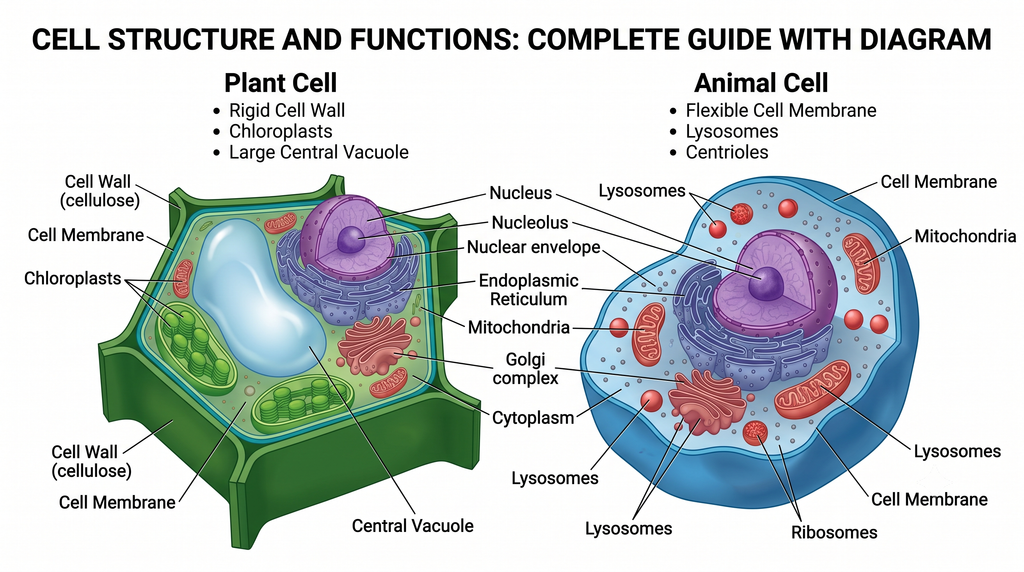
Plant Cell
Cells belonging to plants are a specific type of eukaryotic cell.
Plant cells contain several structures shared with animal cells, but they also have specialized structures such as the cell wall, chloroplasts, and a prominent central vacuole.
Major characteristics of plant cells
- Cell wall
- Cell membrane
- Cytoplasm
- Nucleus
- Chloroplasts
- Large central vacuole
- Mitochondria
- Ribosomes
- Endoplasmic reticulum
- Golgi apparatus
The cell wall provides structural support, while chloroplasts enable photosynthesis in photosynthetic plant cells.
Animal Cell
Animal cells are the eukaryotic units that make up animal tissues.
Unlike plants, animal cells possess a pliable outer membrane but lack both chloroplasts and a cell wall made of cellulose.
Major structures include:
- Cell membrane
- Cytoplasm
- Nucleus
- Mitochondria
- Ribosomes
- Endoplasmic reticulum
- Golgi apparatus
- Lysosomes
- Small vacuoles
- Centrioles in many animal cells
Animal cells vary greatly in structure and function.
For example, a nerve cell is specialized for transmitting signals, while a red blood cell is specialized for transporting oxygen.
Plant Cell vs Animal Cell
| Feature | Plant Cell | Animal Cell |
|---|---|---|
| Cell wall | Present | Absent |
| Chloroplasts | Present in photosynthetic plant cells | Absent |
| Cell membrane | Present | Present |
| Nucleus | Present | Present |
| Central vacuole | Usually large and prominent | Usually smaller |
| Shape | Often more rigid or regular | Often flexible and variable |
| Mitochondria | Present | Present |
| Ribosomes | Present | Present |
Important: Plant cells also perform cellular respiration. Photosynthesis does not replace respiration.
Cell Organelles and Their Functions
Cell organelles are specialized structures that perform specific functions within cells.
Understanding the function of each organelle is one of the most important foundations of cell biology.
1. Cell Membrane
The cell membrane, often called the plasma membrane, encloses the entire cell.
It creates a physical barrier that separates the inside of the cell from its outer surroundings.
Functions
- Controls the movement of substances into and out of the cell
- Works to keep the cell’s inner conditions stable and balanced.
- Plays a key role in how cells send and receive messages from one another.
- Helps maintain cellular integrity
The membrane is selectively permeable, meaning that different substances cross it in different ways.
Easy way to remember
Cell membrane = Security gate
It decides what can enter and leave.
2. Cell Wall
The cell wall is a rigid structure outside the cell membrane in plant cells.
In plants, the cell wall is primarily composed of cellulose.
Functions
- Provides structural support
- Assists in keeping the overall structure and physical shape of the cell.
- Protects the cell
- Helps prevent excessive expansion when water enters the cell
Easy way to remember
Cell wall = Protective building wall
3. Cytoplasm
The cytoplasm is the region inside the cell membrane that contains the cell’s internal structures.
It includes the cytosol and the structures suspended within it.
Functions
- Provides an environment for many biochemical reactions
- Supports organelles
- Helps materials move within the cell
4. Nucleus
The nucleus is a membrane-bound organelle that contains most of the cell’s genetic material in eukaryotic cells.
It plays a central role in regulating gene expression and cellular activities.
Functions
- Stores genetic information
- Regulates gene expression
- Helps control cell growth and development
- Has an important job in the process where a cell splits to make new cells.
Easy way to remember
Nucleus = Control center
5. Nucleolus
The nucleolus is a region within the nucleus.
It is particularly important in the production and assembly of ribosomal components.
Main function
Ribosome production and assembly
Memory trick
Nucleolus → Ribosomes
6. Mitochondria
Mitochondria are organelles involved in cellular energy metabolism.
They generate much of the cell’s ATP through processes associated with cellular respiration.
Functions
- Produce ATP
- Participate in cellular respiration
- Provides the energy needed for the cell to perform its varied and busy activities.
Mitochondria contain their own DNA and have characteristics supporting the endosymbiotic theory of their evolutionary origin.
Easy way to remember
Mitochondria = Cellular power stations
7. Ribosomes
Ribosomes are molecular structures responsible for protein synthesis.
They can be found freely in the cytoplasm or associated with the rough endoplasmic reticulum.
Functions
- Read messenger RNA
- Assemble amino acids into proteins
- Support protein production required for cellular functions
Memory trick
Ribosome = Protein factory
8. Endoplasmic Reticulum
The endoplasmic reticulum (ER) is an interconnected membrane system within eukaryotic cells.
It has two major forms.
Rough Endoplasmic Reticulum
The rough ER has ribosomes attached to its surface.
Functions
- Produces proteins destined for secretion or membranes
- Helps fold and process newly synthesized proteins
- Is involved in moving proteins from one place in the cell to another.
Smooth Endoplasmic Reticulum
The smooth ER lacks ribosomes on its surface.
Functions
- Lipid synthesis
- Detoxification reactions in certain cells
- Calcium storage and regulation in specialized cells
Memory trick
Rough ER → Ribosomes → Proteins
Smooth ER → Lipids and other metabolic functions
9. Golgi Apparatus
The Golgi apparatus is involved in modifying, sorting, and packaging proteins and lipids.
It receives materials from the endoplasmic reticulum and prepares them for delivery to different destinations.
Functions
- Makes changes and adjustments to proteins and fats after they are created.
- Sorts cellular materials
- Bundles molecules together and puts them into small sacs called vesicles for transport.
- Participates in secretion
Easy way to remember
Golgi apparatus = Post office
It sorts and sends packages to the correct destination.
10. Lysosomes
Lysosomes are membrane-bound organelles containing digestive enzymes.
They are especially important in the breakdown and recycling of cellular materials.
Functions
- Break down macromolecules
- Digest damaged cellular components
- Participate in cellular recycling
- Help destroy certain foreign materials
Easy way to remember
Lysosome = Recycling center
11. Vacuoles
Vacuoles are membrane-bound compartments used for storage and other cellular functions.
In many plant cells, a large central vacuole occupies a significant portion of the cell.
Functions
- Store water
- Store ions and other substances
- Store waste products
- Helps to keep the fluid pressure right inside plant cells so they stay firm.
Plant cells
The large central vacuole contributes to turgor pressure, helping plants maintain firmness.
12. Chloroplasts
Chloroplasts are special cell structures found primarily in plants and many kinds of algae.
They contain chlorophyll and are the primary sites of photosynthesis in photosynthetic eukaryotic cells.
Functions
- Capture light energy
- Carry out photosynthesis
- Produce carbohydrates from carbon dioxide and water using light energy
Simplified photosynthesis equation
Carbon dioxide + Water + Light Energy → Glucose + Oxygen
Memory trick
Chloroplast = Solar energy factory
13. Centrosome and Centrioles
In animal cells, the centrosome is an important microtubule-organizing center.
It contains a pair of centrioles in many animal cells.
Functions
- Helps organize microtubules
- Plays a role in cell division
- Helps organize the mitotic spindle
The precise organization and presence of centrioles can vary among different eukaryotic organisms, so it is better to avoid the oversimplification that every eukaryotic cell has centrioles.
Cell Organelles at a Glance
| Cell Structure | Main Function |
|---|---|
| Cell membrane | Controls movement of substances |
| Cell wall | Support and protection |
| Cytoplasm | Environment for many cellular reactions |
| Nucleus | Stores DNA and regulates gene activity |
| Nucleolus | Produces and assembles ribosomal components |
| Mitochondria | ATP production and energy metabolism |
| Ribosomes | Protein synthesis |
| Rough ER | Protein synthesis and processing |
| Smooth ER | Lipid synthesis and other metabolic functions |
| Golgi apparatus | Modification, sorting and packaging |
| Lysosomes | Breakdown and recycling |
| Vacuole | Storage and water balance |
| Chloroplast | Photosynthesis |
| Centrosome | Microtubule organization |
How Cell Organelles Work Together
Cell organelles do not work independently. They operate as an interconnected system.
For example, consider how a cell produces and secretes a protein.
Step 1: DNA
A gene in DNA contains the information needed to produce a protein.
Step 2: Nucleus
The genetic information is transcribed into messenger RNA.
Step 3: Ribosome
The ribosome reads the messenger RNA and builds the protein.
Step 4: Rough ER
If the protein is destined for secretion or a membrane, it enters the rough ER-associated pathway.
Step 5: Transport Vesicle
The protein is transported toward the Golgi apparatus.
Step 6: Golgi Apparatus
The protein is modified, sorted, and packaged.
Step 7: Vesicle
A vesicle transports the protein to its destination.
This example shows that cell biology is not simply a list of organelles. It is a coordinated system.
Cell Structure Analogy
A cell can be compared with a well-organized city:
| Cell Structure | City Analogy |
|---|---|
| Nucleus | City administration |
| Cell membrane | Security boundary |
| Mitochondria | Power stations |
| Ribosomes | Manufacturing units |
| Rough ER | Manufacturing and transport network |
| Golgi apparatus | Distribution center |
| Lysosomes | Recycling facilities |
| Vacuole | Storage facility |
| Cytoplasm | Internal working environment |
| Chloroplast | Solar-energy facility |
These analogies can help beginners remember cell functions, but the biological functions should always be learned alongside the analogy.
Why Is Cell Biology Important?
Cell biology is fundamental to many areas of science and medicine.
Understanding cells helps scientists study:
- Genetic diseases
- Cancer
- Infections
- Immunity
- Development
- Tissue repair
- Biotechnology
- Drug development
- Stem-cell research
- Agriculture
- Genetic engineering
Many medical treatments work by affecting processes that occur inside cells.
Common Misconceptions
Misconception 1: Plant cells do not respire.
Incorrect.
Plant cells perform cellular respiration. Photosynthesis and cellular respiration are different processes.
Misconception 2: All cells contain a nucleus.
Incorrect.
Prokaryotic cells do not contain a membrane-bound nucleus.
Misconception 3: Mitochondria are only found in animal cells.
Incorrect.
Plant cells also contain mitochondria.
Misconception 4: Chloroplasts are present in every plant cell.
Incorrect.
Not every plant cell contains chloroplasts. Chloroplasts occur in specialized photosynthetic cells and tissues.
Misconception 5: The cell wall and cell membrane are the same thing.
Incorrect.
The cell membrane is a selectively permeable biological membrane. The plant cell wall is a rigid supporting structure outside the membrane.
Exam Tips
For school and competitive examinations, pay particular attention to:
- Differences between prokaryotic and eukaryotic cells.
- Plant cell vs animal cell.
- Functions of major organelles.
- Structure and function of mitochondria.
- Structure and function of chloroplasts.
- Role of ribosomes in protein synthesis.
- Functions of the Golgi apparatus.
- Cell Theory.
- Cell membrane versus cell wall.
- Relationship between DNA, RNA, ribosomes, ER, and Golgi apparatus.
Quick Revision Notes
One-line revision
- Cell: Basic structural and functional unit of life
- Nucleus: Contains most cellular DNA in eukaryotic cells
- Mitochondria: Major site of ATP production
- Ribosomes: Protein synthesis
- Rough ER: Protein processing and transport
- Smooth ER: Lipid synthesis and other metabolic functions
- Golgi apparatus: Modification, sorting and packaging
- Lysosomes: Breakdown and recycling
- Vacuole: Storage and water balance
- Chloroplast: Photosynthesis
- Cell membrane: Selective barrier
- Cell wall: Structural support in plants
Practice MCQs
1. What is considered the basic structural and functional unit of life?
A. Tissue
B. Organ
C. Cell
D. Organ system
Answer: C. Cell
2. Who first used the term “cell” after observing cork?
A. Theodor Schwann
B. Robert Hooke
C. Rudolf Virchow
D. Matthias Schleiden
Answer: B. Robert Hooke
3. Which type of cell lacks a membrane-bound nucleus?
A. Plant cell
B. Animal cell
C. Eukaryotic cell
D. Prokaryotic cell
Answer: D. Prokaryotic cell
4. Which organelle is primarily associated with ATP production?
A. Golgi apparatus
B. Ribosome
C. Mitochondrion
D. Lysosome
Answer: C. Mitochondrion
5. Which structure is responsible for protein synthesis?
A. Ribosome
B. Lysosome
C. Vacuole
D. Chloroplast
Answer: A. Ribosome
6. Which organelle modifies and sorts many proteins and lipids?
A. Nucleus
B. Golgi apparatus
C. Ribosome
D. Cell wall
Answer: B. Golgi apparatus
7. Which structure is characteristic of plant cells but absent from animal cells?
A. Mitochondria
B. Ribosomes
C. Chloroplasts
D. Cell membrane
Answer: C. Chloroplasts
8. What is the primary function of the cell membrane?
A. Protein synthesis
B. Photosynthesis
C. Controlling movement of substances
D. DNA replication
Answer: C. Controlling movement of substances
9. Which organelle contains chlorophyll in photosynthetic plant cells?
A. Mitochondrion
B. Chloroplast
C. Golgi apparatus
D. Lysosome
Answer: B. Chloroplast
10. Which structure provides rigidity and support to plant cells?
A. Cell wall
B. Ribosome
C. Nucleus
D. Cytoplasm
Answer: A. Cell wall
11. Which organelle contains enzymes involved in intracellular digestion?
A. Lysosome
B. Ribosome
C. Chloroplast
D. Nucleolus
Answer: A. Lysosome
12. Which structure is directly involved in producing ribosomal components?
A. Nucleolus
B. Lysosome
C. Vacuole
D. Cell wall
Answer: A. Nucleolus
13. Rough endoplasmic reticulum is called “rough” because it has:
A. DNA
B. Chlorophyll
C. Ribosomes
D. Lysosomes
Answer: C. Ribosomes
14. Which organelle is particularly important for lipid synthesis?
A. Smooth ER
B. Ribosome
C. Nucleus
D. Lysosome
Answer: A. Smooth ER
15. What is a major function of the large central vacuole in plant cells?
A. DNA replication
B. Maintaining turgor and storing substances
C. Protein synthesis
D. Producing ribosomes
Answer: B. Maintaining turgor and storing substances
Frequently Asked Questions
What is a cell?
A cell is the smallest structural and functional unit of life. It performs the essential processes required for maintaining life.
What are cell organelles?
Cell organelles are specialized structures within cells that perform particular functions.
What is the difference between prokaryotic and eukaryotic cells?
Prokaryotic cells lack a membrane-bound nucleus, while eukaryotic cells contain a membrane-bound nucleus and various membrane-bound organelles.
What is the function of mitochondria?
Mitochondria are major sites of ATP production and cellular energy metabolism.
What is the function of ribosomes?
Ribosomes synthesize proteins by translating information carried by messenger RNA.
What is the function of the Golgi apparatus?
The Golgi apparatus modifies, sorts, and packages proteins and lipids for transport within or outside the cell.
Why do plant cells have chloroplasts?
Chloroplasts contain chlorophyll and carry out photosynthesis in photosynthetic plant cells.
Do plant cells have mitochondria?
Yes. Plant cells contain mitochondria and perform cellular respiration.
Do all plant cells contain chloroplasts?
No. Chloroplasts are present mainly in photosynthetic tissues and are absent from many specialized non-photosynthetic plant cells.
What is the cell membrane?
The cell membrane is a selectively permeable membrane that separates the cell from its surroundings and regulates the movement of substances.
Frequently Confused Terms
| Term | Meaning |
|---|---|
| Cell membrane | Selectively permeable boundary around the cell |
| Cell wall | Rigid supporting structure outside the membrane in plants |
| Cytoplasm | Internal region containing cytosol and cellular structures |
| Cytosol | Fluid component of the cytoplasm |
| Nucleus | Membrane-bound compartment containing most eukaryotic DNA |
| Nucleolus | Nuclear region involved in ribosome production |
| Chromosome | DNA-protein structure carrying genetic information |
STEMRize Learning Challenge
Try answering these without looking back:
- Why is the cell called the basic unit of life?
- What is the major difference between prokaryotic and eukaryotic cells?
- Why are mitochondria important?
- What is the relationship between ribosomes, rough ER, and the Golgi apparatus?
- Why can plant cells perform both photosynthesis and cellular respiration?
- What makes the cell membrane different from the cell wall?
If you can explain these six questions in your own words, you have a strong foundation in cell biology.
Key Takeaways
- Cells are the fundamental units of living organisms.
- Robert Hooke introduced the term “cell” after observing cork.
- Cell Theory describes the fundamental role of cells in life.
- Prokaryotic cells lack a membrane-bound nucleus.
- Eukaryotic cells contain a membrane-bound nucleus.
- Plant and animal cells share many structures but also have important differences.
- Mitochondria are central to cellular energy metabolism.
- Ribosomes synthesize proteins.
- The ER and Golgi apparatus work together in processing and transporting many cellular products.
- Chloroplasts perform photosynthesis in photosynthetic plant cells.
- The cell membrane regulates interactions between the cell and its environment.
References and Further readings
The article has been written in original language and checked against authoritative educational resources. References are provided for further study and verification.
- OpenStax. Biology 2e. Rice University.
Topics: Cell Structure, Eukaryotic Cells, Prokaryotic Cells, Cell Organelles. - National Council of Educational Research and Training (NCERT). Biology – Class XI.
Chapter: Cell: The Unit of Life. - Urry, L. A., Cain, M. L., Wasserman, S. A., Minorsky, P. V., & Orr, R. B. Campbell Biology, 12th Edition. Pearson.
- Encyclopaedia Britannica. Cell – Biology.
Reference material on cell structure, organization, and biological functions. - National Center for Biotechnology Information (NCBI), National Library of Medicine.
Educational and scientific resources relating to cell biology and molecular biology.
Copyright note: Content on STEMRize is independently researched and written for educational purposes. All explanations and diagrams are original unless explicitly stated otherwise. External works are cited solely for academic reference and verification under standard fair use principles. If you have questions or copyright inquiries, please contact us here.
Suggested Internal Links
Add these links as the corresponding STEMRize articles become available:
- Plant Cell vs Animal Cell
- Cell Organelles and Their Functions
- Cell Theory
- Prokaryotic vs Eukaryotic Cells
- Mitosis vs Meiosis
- DNA Structure and Functions
- RNA Structure and Functions
- Photosynthesis
- Cellular Respiration
- Biomolecules
